

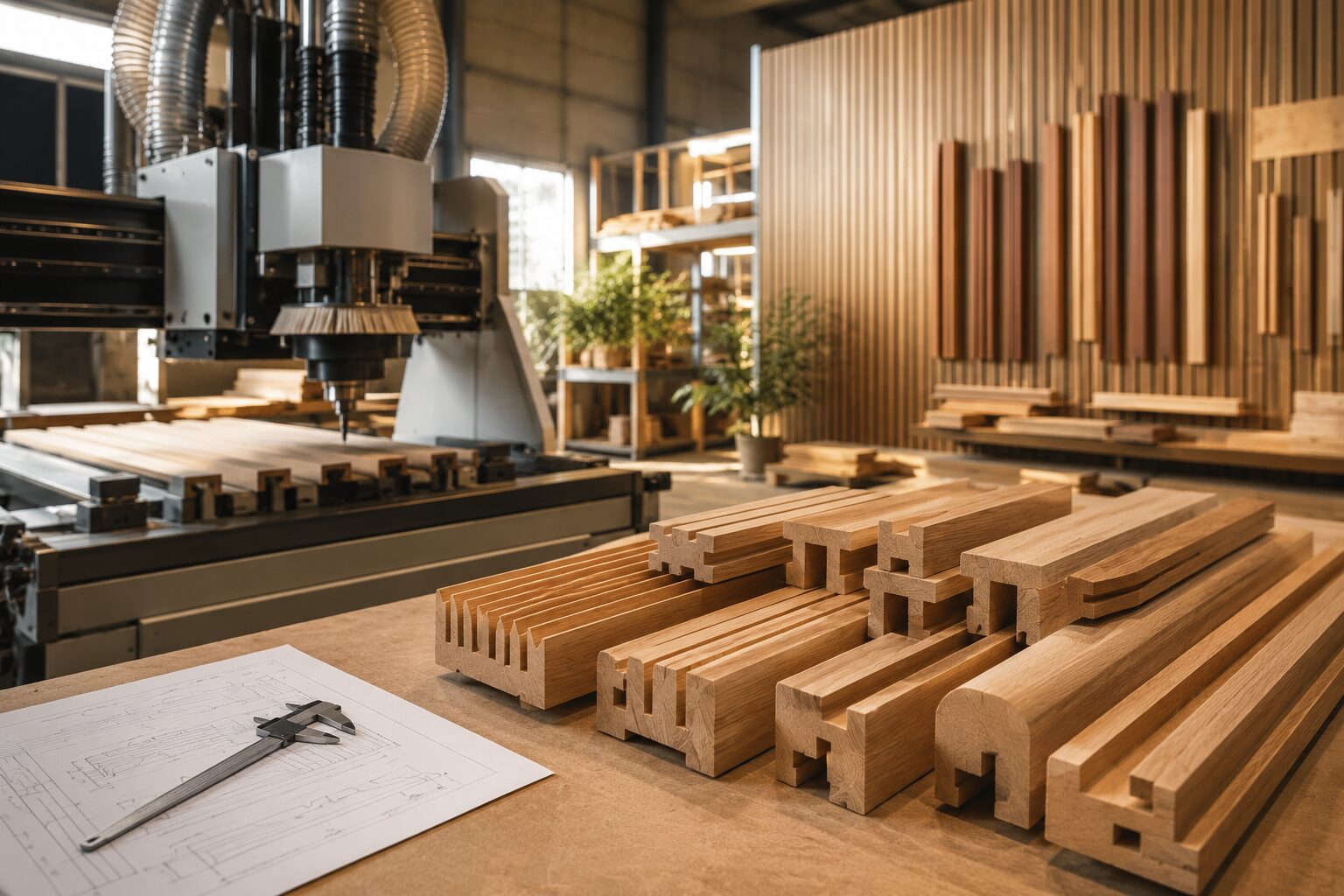
Beyond the Standard Range: Custom Machining at Timbeck
Some projects fit neatly inside the standard product range. A standard cladding profile, a standard panelling width, a standard moulding section, and the brief is met. Plenty of projects, though, ask for something the standard catalogue does not cover. A heritage building that needs an architrave profile faithfully matched. A modern facade that calls for a wider board than anyone stocks. A custom acoustic panel with a specific groove rhythm. A bespoke handrail or sauna component. These are the projects where custom machining earns its place, and where the depth of a real manufacturing facility matters far more than the depth of a catalogue. Timbeck has been manufacturing premium timber products in Australia for more than 50 years, and custom machining is a core part of what we do. This guide is for architects, builders, and joiners who want to understand what is possible and how to brief us efficiently.
What Custom Machining Covers
Custom machining is the process of running real timber through purpose-set tooling to produce profiles, dimensions, and surfaces that match a specific drawing rather than a standard product. At Timbeck, it includes cladding profiles, panelling profiles, mouldings, architraves, decking, dressed sections, shutter and blind components, sauna timbers, and architectural screening battens. If the timber needs a specific shape, edge, groove, or surface texture, the machining floor can usually deliver it.
Full product information sits on the custom machining page, with related products under mouldings, architraves, and dressed boards.
Common Projects That Need Custom Machining
The applications that most often need a custom run rather than a stock product include:
- Heritage restoration, where the existing moulding or architrave is being matched to retain authentic character
- Architectural cladding, where a non-standard cover width or shadow line is critical to the design
- Acoustic panelling, where the slat width, gap, and depth are specified to deliver a particular acoustic outcome
- Sauna and wet-area joinery, where bespoke seating and lining components are required
- Custom decking or platforms, where the section size or grooving differs from stock decking
- Designer joinery elements, including handrails, mantels, columns, and bespoke trims
In each case, the goal is the same. The timber arrives on site already shaped the right way, with the right tolerance, ready to install without on-site rework.
What to Send When You Brief Us
A clear brief makes the quote faster and the result better. The most useful information for a custom machining enquiry:
- A drawn profile, ideally to scale, showing the section dimensions, grooves, and edges
- The intended species, or a request for our recommendation
- The total linear metres required, with allowance for wastage
- The required tolerance and surface finish
- Whether the timber needs to be supplied raw, primed, or finished
- The intended application, so we can advise on detailing
- The required delivery date and any sequencing constraints
Sketches, CAD profiles, and physical samples are all welcome. If you already have a section of an existing timber that needs to be matched, send a photograph and dimensions, and our team can advise on whether a match is feasible.
Species and Material Considerations
Not every profile suits every species. Dense Australian hardwoods such as Spotted Gum and Blackbutt hold sharp profiles and tight tolerances well, making them suitable for both rugged exterior sections and clean interior trims. Softer imported softwoods such as Western Red Cedar and Hemlock are excellent for wider, lighter profiles and large-area cladding. The team can help match species to profile during the quote, so the section you specify can actually be produced cleanly in the species you want.
Pre-Finishing as Part of the Run
One of the practical advantages of running a custom profile through Timbeck is that the same job can flow straight into the coating line. Boards leave the machining floor and enter the coating and finishing process before they ever reach the site, with all faces sealed and the colour drawn from our colour range or matched to a custom reference. That shortens the on-site programme and gives a more uniform result than coating after install.
Send Us Your Brief
If the standard range does not quite suit your design, custom machining usually can. The Timbeck team has produced everything from a single moulding match for a heritage cottage to multi-thousand-metre runs for commercial fit-outs. Get in touch through our contact page, request a quote, or explore customised solutions to start the conversation.
