

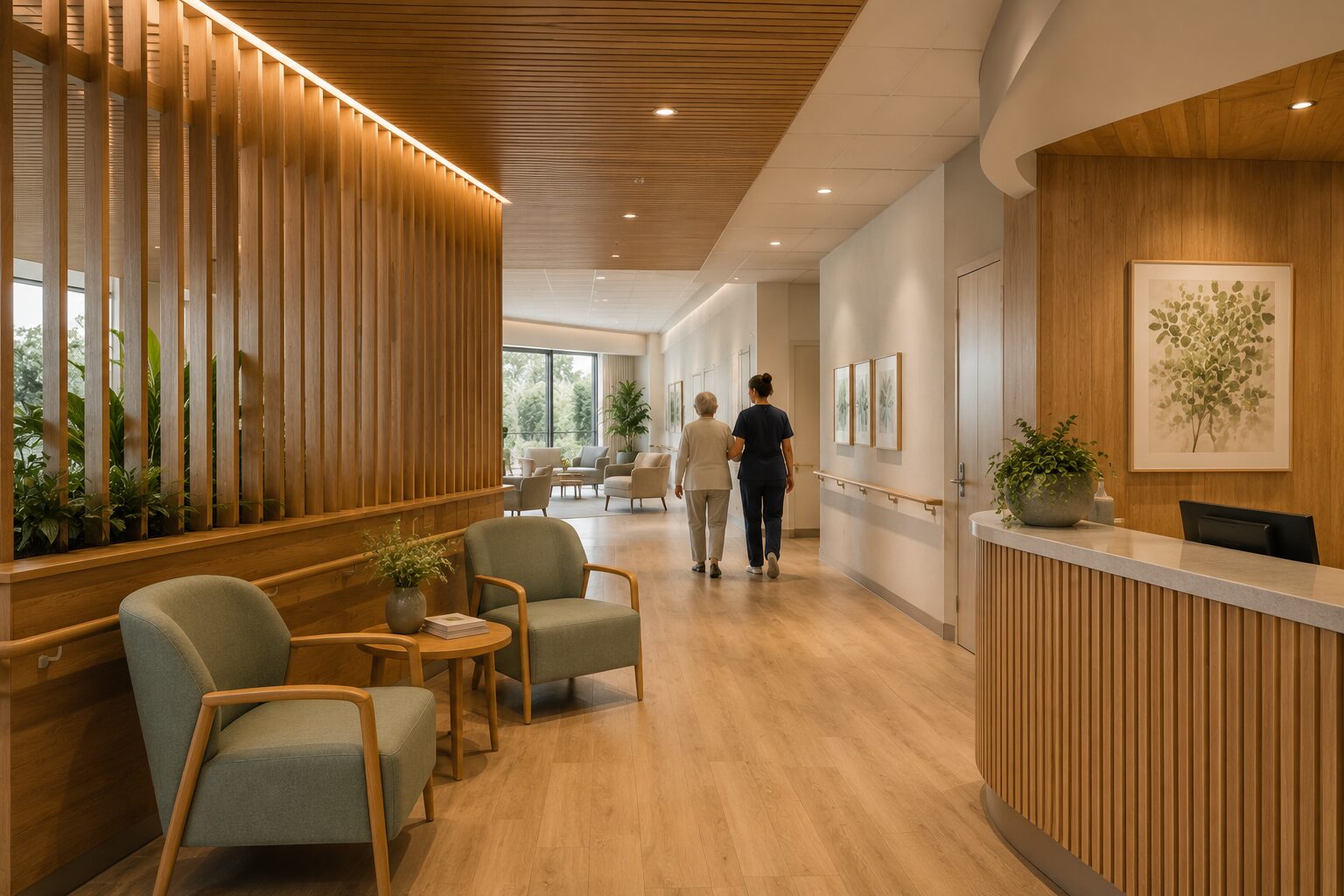
Designing Healthcare Spaces That Feel Less Like Hospitals
Healthcare and aged care interiors are a different design challenge to almost any other building type. They have to be functional, clinical-grade, and easy to maintain, but they also have to feel safe, calm, and humane for the people who live and work in them. For decades, the answer was vinyl, laminate, and washable paint in tight floor-to-ceiling palettes that prioritised cleaning over comfort. Increasingly, the conversation has shifted. Biophilic design, mental wellbeing research, and the simple realisation that residents do better in warmer environments have all opened the door for natural materials in healthcare settings. Timber is one of the most powerful tools available, when specified properly. This guide is for architects, interior designers, and facility managers thinking about how timber can be used in aged care and healthcare without compromising on hygiene, durability, or compliance.
Why Timber Belongs in Healthcare
The evidence base for natural materials in healthcare design has grown steadily over the past two decades. Studies in aged care, hospital wards, mental health units, and consulting rooms point to lower stress markers, improved mood, and better-rated patient experience where timber and other natural materials are visible. The reasons are not surprising. Timber breaks the institutional cue that hard, glossy, white interiors send. It connects the building to the natural world. It softens light, reduces glare, and adds tonal warmth to spaces that would otherwise feel flat. For ageing residents in particular, the familiarity of timber surfaces has practical value, anchoring the space in something domestic rather than clinical.
Where Timber Works Best
Healthcare design generally divides interiors into back-of-house clinical zones, transitional areas, and resident or visitor-facing zones. Timber works best in the second and third categories, where the cleaning regime is less aggressive and the human experience is more central. Common applications include:
- Foyers and waiting rooms, where the first impression sets the tone
- Living rooms and lounges in aged care, where residents spend most of their day
- Corridors and circulation spaces, where timber panelling can soften long sightlines
- Dining rooms, where the warmth of timber helps build a domestic atmosphere
- Chapels, gardens, and reflection spaces, where stillness matters
- Consulting rooms in private practice, where the patient experience supports recovery
Our panelling and architectural screening ranges are particularly well-suited to these applications, in both hardwood and softwood options.
Hygiene and Cleaning Considerations
The most common concern raised about timber in healthcare is whether it can be kept clean. The answer is yes, provided the finish is right. A factory-applied coating that fully seals the surface gives timber the same cleanability as many of the more clinical alternatives. The finish can be wiped down with standard healthcare cleaning agents, resists staining, and prevents moisture penetration. Our coating and finishing service can recommend systems suited to the cleaning protocols of aged care and healthcare environments, including matte finishes that hide minor wear and gloss finishes for high-cleaning zones.
Durability and Resident Wear
Aged care facilities in particular need finishes that hold up to mobility aids, beds, and trolleys that pass close to walls many times per day. Dense Australian hardwoods such as Blackbutt and Spotted Gum are well suited to high-traffic linings, with the density to take knocks without major damage and the tonal richness to give the space a sense of presence. For ceiling and upper-wall applications away from high-contact zones, lighter softwoods such as Hemlock and Western Red Cedar offer a brighter, more open feel.
Acoustic and Wellbeing Benefits
Acoustic comfort is one of the underrated dimensions of healthcare design. Hard surfaces in waiting rooms, dining rooms, and circulation spaces build reverberation that makes conversation harder and stress higher. Slatted timber panelling, backed with an acoustic substrate, can take reverberation down significantly while preserving the warm appearance of the room. The same product solves two problems at once, which is what good healthcare specification looks for.
Sustainability and Indoor Air Quality
Many healthcare projects target Green Star ratings, WELL certification, or local sustainability commitments, and increasingly look at indoor air quality as part of the brief. Specifying certified timber with low-VOC finishes supports those goals. Timbeck is a PEFC-certified supplier, and our standard coatings can be specified with low-VOC formulations suited to healthcare interiors. Full information on certified options is available on our cedar products and hardwood products pages.
Designing Better Healthcare With Timbeck
Timber is not a substitute for clinical-grade materials in surgical or sterile zones. It is, however, one of the most effective tools available for the parts of a healthcare or aged care building where people live, recover, wait, and spend the rest of their day. Specifying it well takes a careful brief, the right species, and the right coating. The Timbeck team has supplied healthcare projects across Australia for many years, and we are happy to help shape a specification that meets the design, hygiene, and durability requirements of your project. Get in touch through our contact page or request a quote to start the conversation.
