Designing for Bushfire-Prone Australia
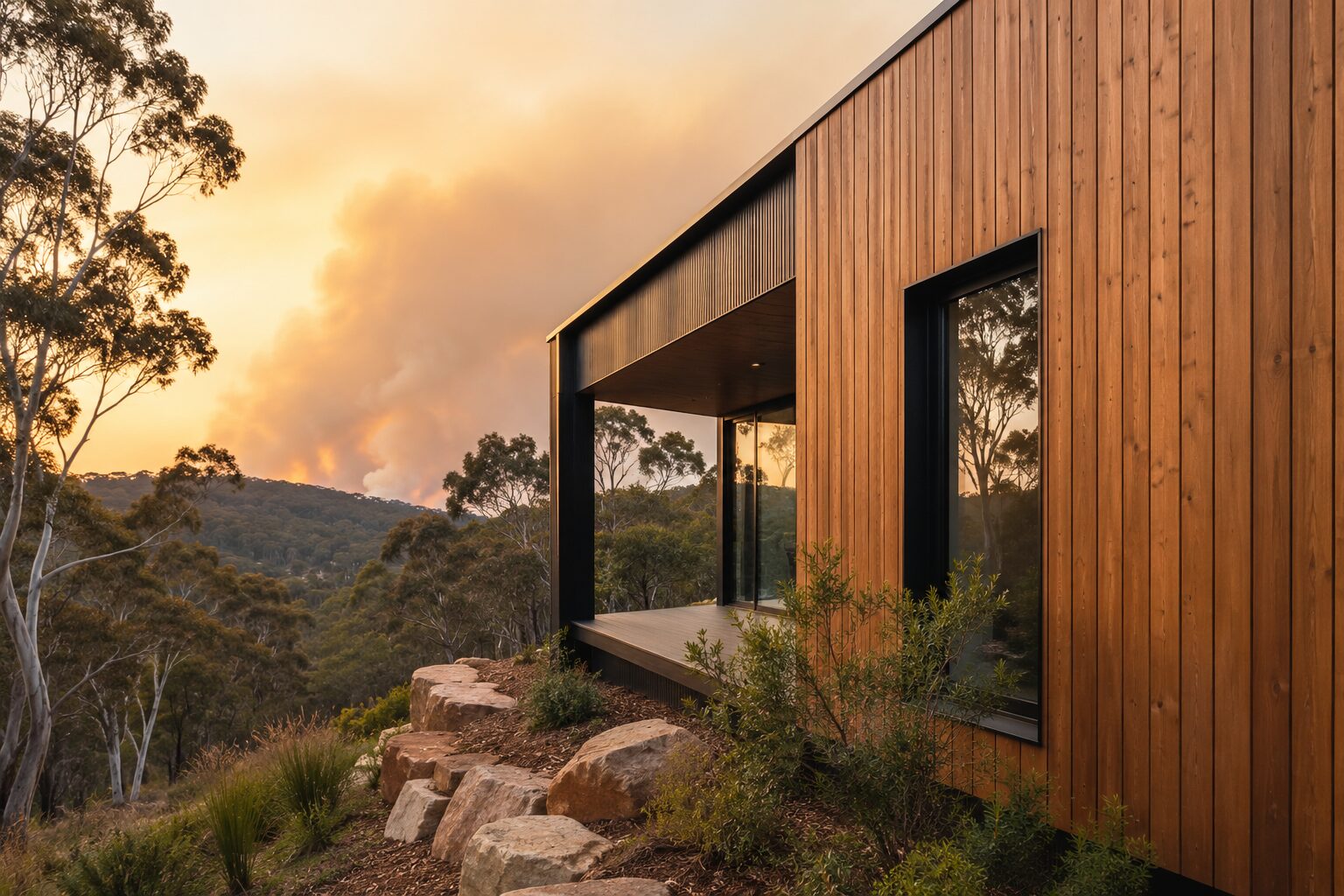
Bushfire risk is part of designing in Australia. Across NSW, Victoria, Queensland, South Australia, and Western Australia, a growing share of new residential and commercial projects sit in declared bushfire-prone areas, which means cladding selection is no longer a purely aesthetic decision. It is a compliance decision, an insurance decision, and one that shapes how a building performs in the worst possible conditions. The good news is that timber, specified properly, can absolutely meet the brief. This guide walks architects, builders, and specifiers through how BAL ratings work, what they mean for timber cladding, and how to use Timbeck’s range to deliver designs that satisfy AS 3959 without giving up on the material’s natural beauty.
Understanding the Six BAL Ratings
The Bushfire Attack Level system, defined under AS 3959-2018, sets out six levels of risk based on a site assessment of vegetation type, slope, and distance from the hazard. From lowest to highest, these are BAL-Low, BAL-12.5, BAL-19, BAL-29, BAL-40, and BAL-FZ (Flame Zone). Each level corresponds to the radiant heat flux a building element is expected to face, measured in kilowatts per square metre, and each level brings progressively stricter construction requirements.
For the lower levels, BAL-Low through BAL-19, the focus is on ember protection. Standard construction with sealed joints and appropriate fixings is typically acceptable, and most timber species can be specified without modification. From BAL-29 upwards, the standard begins to nominate bushfire-resisting timbers and additional construction measures. BAL-FZ is the most demanding category and usually requires a fully tested system rather than a single product.
Bushfire-Resisting Timber Species
AS 3959 lists seven species recognised as bushfire-resisting timbers, including Spotted Gum, Blackbutt, Red Ironbark, Silvertop Ash, Turpentine, Kwila (Merbau), and River Red Gum. These species have densities and structural characteristics that make them more resistant to ignition and progressive flame spread under the test conditions specified in the standard.
Two of these species, Spotted Gum and Blackbutt, sit at the heart of Timbeck’s hardwood range. Both deliver the visual richness Australian projects are known for, both are sourced from sustainable Australian forests, and both can be specified with confidence in BAL-12.5, BAL-19, and BAL-29 applications, subject to proper detailing of the supporting structure. For higher ratings, the cladding system as a whole, including substrate, fixings, joints, and adjacent elements, becomes the controlling factor.
Detailing That Makes the Difference
Even a bushfire-resisting species can fail if the system around it is wrong. The detailing of joints, gaps, fixings, sub-frames, and edge protection has a significant effect on real-world performance. The standard sets out requirements for maximum gap sizes between boards, the need for ember-proof seals at penetrations, and minimum thicknesses for solid timber elements. Specifiers should also pay close attention to where the cladding meets eaves, windows, decks, and roofs, as these junctions are common ignition points in real fires.
Our team can supply cladding and cladding and weatherboards in profiles that suit your detailing requirements, with custom machining available where the standard profiles do not match the design intent.
Finishes and Coatings for Bushfire Areas
Factory-applied coatings do more than improve appearance and shorten programme time on site. A properly specified coating system protects the substrate from moisture, UV, and surface degradation, which in turn helps the timber retain the density and integrity assumed by the BAL standard. Pre-finished boards arrive ready to install, with all six faces sealed, which is an advantage no on-site coating can match.
Timbeck’s coating and finishing service covers a wide range of fire-considered coatings, and our specialists can advise on systems that suit the BAL category, exposure direction, and visual outcome you are targeting.
What to Send Us When You Request a Quote
The faster your project moves from sketch to site, the more useful a complete brief is. When requesting a quote for a bushfire-rated project, we recommend including:
- The BAL rating from your bushfire attack assessment
- The project location and orientation, particularly the face exposed to the hazard
- Linear metres or square metres of cladding required
- Preferred species, profile, and finish, or a request for our recommendation
- Any specific authority requirements set by your local council or certifier
- The construction programme, so we can sequence machining and coating accordingly
The more we know upfront, the better the advice we can give about species, profiles, and coatings that will suit both the standard and the design.
Working With Timbeck on BAL Projects
Compliance, sustainability, and aesthetics no longer have to pull in different directions. With the right species, the right profile, and the right coating system, timber cladding can deliver a building that meets the standard, performs in the climate, and still looks like the design you set out to build. Talk to the Timbeck team early in the specification process and we will help you size up the right system. Reach out through our contact page, request a quote, or explore customised solutions if your project sits outside the standard range.
